
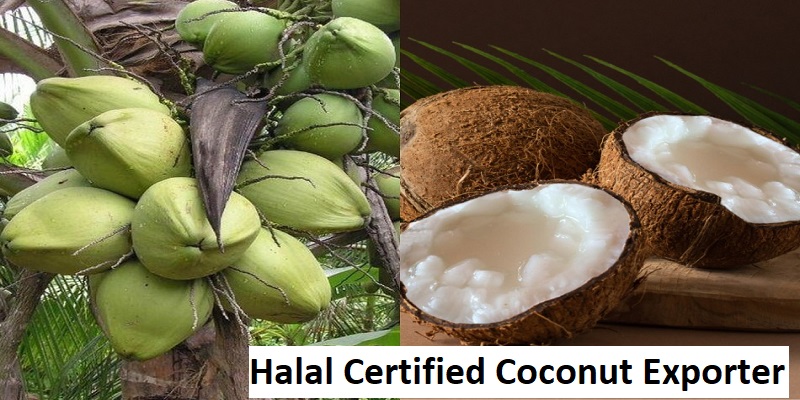
In today’s globalized economy, the demand for halal products has grown exponentially. Beyond meat and processed foods, even plant-based products like coconut and its derivatives are now expected to meet halal standards, especially when exported to Muslim-majority markets. This shift has led to the rise of a specialized segment: the halal certified coconut exporter.
This article explores what it means to be a halal certified coconut exporter, the process of halal certification, why it matters, the wide range of coconut products that can be certified, and how exporters can leverage halal certification to expand globally.
What Is Halal and Why Does It Matter?
The word halal comes from Arabic, meaning “permissible” or “lawful.” In the context of food and beverages, halal products are those that comply with Islamic dietary laws. This means they:
- Do not contain any forbidden (haram) ingredients like pork or alcohol.
- Are processed, manufactured, and stored without cross-contamination with non-halal items.
- Meet strict hygiene and quality standards.
For the world’s 1.9 billion Muslims, consuming halal food isn’t just a lifestyle choice—it’s a religious obligation. As a result, halal certification isn’t merely a marketing tool; it is often a legal requirement for selling in countries like Indonesia, Malaysia, Brunei, Saudi Arabia, and other Gulf states.
The Global Demand for Halal Coconut Products
Coconut and its derivatives are used widely in food, cosmetics, pharmaceuticals, and wellness products. The rising popularity of natural, organic, and plant-based products has fueled global demand for coconut-based goods.
When these products are halal certified, they appeal not only to Muslim consumers but also to health-conscious and ethical consumers worldwide who associate halal with:
- Strict quality standards
- Ethical sourcing
- Safe, clean production processes
By becoming a halal certified coconut exporter, businesses can unlock vast markets across:
- Southeast Asia (Indonesia, Malaysia, Brunei)
- The Middle East (UAE, Saudi Arabia, Qatar, Kuwait)
- South Asia (Pakistan, Bangladesh)
- Muslim communities in Europe, North America, and Africa
What Does a Halal Certified Coconut Exporter Do?
A halal certified coconut exporter specializes in producing, processing, packaging, and exporting coconut products that have been officially certified as halal by a recognized halal certification body.
This typically includes:
✅ Sourcing coconuts from trusted farms following halal-compliant practices
✅ Ensuring the production process avoids contamination with haram (forbidden) substances
✅ Using halal-approved additives, packaging materials, and processing aids
✅ Undergoing regular audits by recognized halal certification organizations
✅ Clearly labeling products with the halal logo for transparency and trust
Popular Halal Certified Coconut Products for Export
A halal certified coconut exporter can offer a diverse range of products, including:
- Virgin Coconut Oil (VCO): Cold-pressed oil widely used in cooking, cosmetics, and wellness.
- Desiccated Coconut: Finely shredded, dried coconut used in baking and confectionery.
- Coconut Water: Natural isotonic drink loved for its hydrating properties.
- Coconut Milk & Coconut Cream: Popular dairy alternatives in cooking.
- Coconut Sugar: A low-glycemic natural sweetener.
- Coconut Chips: Healthy snack option.
- Activated Carbon & Charcoal: Made from coconut shells, used in water filtration and cosmetics.
- Coir Products: Mats, ropes, and other products made from coconut husk fiber.
These products can be shipped worldwide, provided they carry a valid halal certificate recognized by importing countries.
Why Halal Certification Is Essential
- Mandatory for many markets:
Countries like Indonesia (the world’s largest Muslim country) have strict halal laws. Products without halal certification may be rejected or heavily taxed. - Competitive advantage:
Halal-certified products stand out in global markets, attracting not just Muslim consumers but anyone seeking assurance of quality and cleanliness. - Higher trust and brand value:
Certification by respected bodies (e.g., JAKIM in Malaysia, MUI in Indonesia) signals commitment to excellence. - Access to premium pricing:
Halal certified coconut products often command better prices due to higher demand and trust.
The Halal Certification Process for Coconut Exporters
Becoming a halal certified coconut exporter involves several steps:
✅ Step 1: Choose a recognized halal certification body
Examples: JAKIM (Malaysia), MUI (Indonesia), MUIS (Singapore), or internationally recognized bodies accredited by the Gulf Accreditation Center (GAC).
✅ Step 2: Audit preparation
- Review ingredients, packaging materials, and processing aids.
- Develop Standard Operating Procedures (SOPs) to avoid contamination.
- Train employees on halal requirements.
✅ Step 3: On-site inspection
Certification auditors will inspect facilities, storage, transportation, and supplier documents.
✅ Step 4: Certification decision
If compliant, the exporter receives a halal certificate, valid for a specified period (often 1–3 years).
✅ Step 5: Ongoing compliance
Regular audits and re-certification ensure continued adherence to halal standards.
Best Practices to Succeed as a Halal Certified Coconut Exporter
- Build a traceable supply chain:
Ensure coconuts and other ingredients come from suppliers who also comply with halal standards. - Invest in clean, modern facilities:
Separate production lines if you also process non-halal products. - Obtain additional certifications:
Organic, Fair Trade, ISO, and HACCP certifications add further credibility. - Focus on branding and packaging:
Highlight the halal logo prominently, share your certification number, and educate customers about what it means. - Understand target markets:
Customize packaging and marketing to meet cultural preferences in the Middle East, Southeast Asia, or Europe. - Leverage digital marketing:
Use SEO-friendly websites, social media, and B2B platforms to reach importers and wholesalers worldwide.
Emerging Trends: Halal, Sustainability, and Innovation
The halal industry is evolving beyond just “permissible” food:
- Plant-based and vegan: Coconut products naturally fit vegan and vegetarian diets, further expanding market reach.
- Clean label: Consumers look for products free of artificial preservatives, colors, and flavors.
- Sustainability: Eco-friendly packaging and fair trade sourcing resonate with ethical consumers.
- Health focus: Virgin coconut oil and coconut water are popular in wellness and sports nutrition markets.
By aligning with these trends, a halal certified coconut exporter can thrive in both traditional Muslim markets and the growing ethical consumer segment.
Success Story: How Halal Certification Transformed a Coconut Business
Imagine a medium-sized coconut processor in Southeast Asia. Initially, their market was limited to local consumers and a few non-Muslim countries.
After obtaining halal certification:
- They secured distribution deals in Malaysia, Indonesia, and the UAE.
- Annual exports doubled within three years.
- They launched premium coconut chips and coconut milk powder under a new halal brand.
- They attended halal expos in Dubai and Kuala Lumpur, gaining international buyers.
Their story shows how halal certification isn’t just about compliance—it can fuel global growth.
Final Thoughts: Why Now Is the Time to Go Halal
The global halal food market is projected to exceed $2.4 trillion by 2026. Coconut products are perfectly positioned to ride this wave, thanks to their natural, plant-based appeal.
For producers and exporters, becoming a halal certified coconut exporter is no longer optional—it’s a strategic move to:
- Access high-demand markets
- Win consumer trust
- Increase profits sustainably
If you are in the coconut business, investing in halal certification today could be your gateway to worldwide success tomorrow.
Conclusion
A halal certified coconut exporter is more than a supplier; it’s a trusted partner delivering quality, safety, and respect for cultural values. With the right certification, commitment to ethical practices, and focus on innovation, coconut businesses can expand into booming halal markets and build resilient global brands.
If you’re ready to take your coconut products global, halal certification could be the key to unlock new horizons
Thông tin liên hệ
Công Ty TNHH Xuất Nhập Khẩu Quốc Tế Đại Việt
Địa chỉ trụ sở: TDP đường 5 Dương Xá, Gia Lâm, Hà Nội
Văn phòng giao dịch: Toà T2 chung cư Handico Trâu Quỳ, Gia Lâm, HN
Địa chỉ xưởng sản xuất: Bình Thạnh 2, Thuận Mỹ, Châu Thành, Long An
Số điện thoại: +84 977743086
Email: [email protected]
Website: daivietinternational.com
